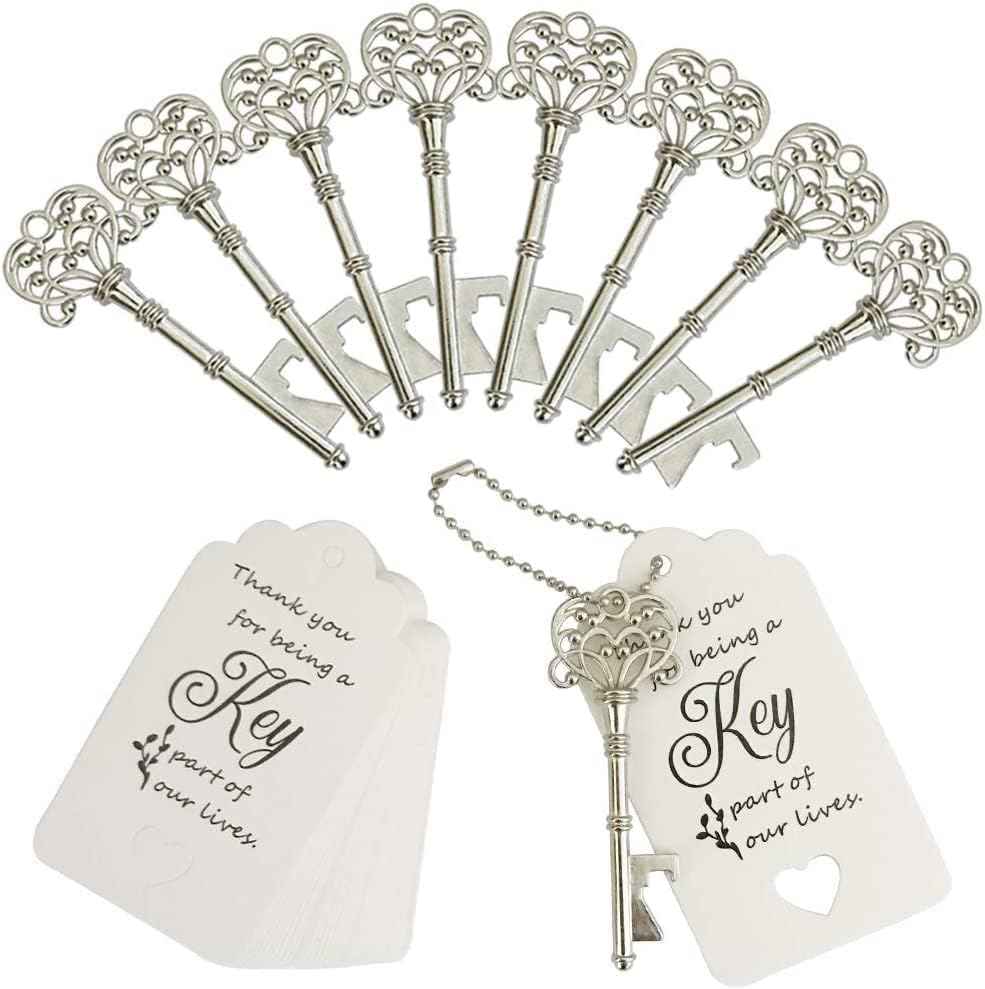
If you’ve ever planned a reception and stared down a spreadsheet of favor options wondering what guests will actually use after the party, bottle opener favors are worth a serious look. A bottle opener — specifically the ornate, old-fashioned kind shaped like a skeleton key (the decorative, vintage-style key shape that’s become a wedding staple) — does something most favors don’t: it’s functional enough to live in a kitchen drawer for years. The skeleton key shape, in particular, has maintained steady appeal because it photographs well on tables, feels substantial in hand, and reads as intentional rather than generic. This guide cuts through the noise on style, material, and price tier so you can make a confident call on whether this category belongs in your favor budget — and if so, exactly which version is worth ordering.
| EDITOR'S PICKAZEN 100 Sets Bulk Gifts | Mid-tier100pcs Personalized Bottle Open… | Budget pick50 PCS Wedding Favors Key Bottl… | |
|---|---|---|---|
| Quantity | 100 sets | 100 | 50 |
| Customizable | — | ✓ | — |
| Lotion included | ✓ | — | — |
| Keychain style | — | ✓ | ✓ |
| Card included | ✓ | — | ✓ |
| Price | $59.99 | $28.99 | $18.58 |
| See on Amazon → | See on Amazon → | See on Amazon → |
Why Bottle Openers Outperform Most Favor Categories on Survivability
The core problem with reception favors is abandonment. Martha Stewart Weddings has reported that decorative-only favors — things like Jordan almonds in tulle, mini picture frames, or candles without scent differentiation — are among the most frequently left behind on tables or discarded within days. The Knot’s 2025 Real Weddings Study reinforced this, noting that guests prioritize keepsakes that have a clear second use in everyday life.
Bottle openers clear that bar. They occupy a permanent utility niche: guests need one in the kitchen, one in the junk drawer, often one at a vacation property. That’s the retention argument. The stronger version of it is that a skeleton key opener is dual-function — it’s a conversation piece and a tool — which is exactly what Town & Country Magazine identifies as the driver behind the “keepsake favor” trend gaining traction in mid-to-premium wedding segments.
The tradeoff to name explicitly: bottle openers work best when your guest list skews toward homeowners or renters in their late 20s through 50s. Younger guests at their first weddings, guests with young children who don’t drink, or heavily corporate lists where dietary or lifestyle variety is unknown — these are populations where the category assumption (everyone wants a bottle opener) needs pressure-testing before you commit to a quantity order of 150 units.
The Four Material Tiers — and What They Actually Cost Per Guest
Skeleton key bottle openers are sold across a wide material and finish range. Here’s where the market clusters as of mid-2026:
By the numbers:
| Tier | Material | Typical per-unit cost | MOQ (minimum order) |
|---|---|---|---|
| Entry | Zinc alloy, brushed silver finish | $2.50–$5.00 | 50–100 units |
| Mid | Antique brass or matte gold, laser-engraved | $7.00–$14.00 | 25–50 units |
| Premium | Solid brass or stainless, hand-stamped | $18.00–$35.00 | 12–25 units |
| Bespoke | Sterling silver, artisan-forged, custom die | $60.00–$150.00+ | 6–12 units |
Entry tier ($2.50–$5.00). These are zinc alloy castings — a metal composite that holds detail well but lacks the weight and durability of solid brass. Reviewers across wholesale favor platforms consistently note that zinc alloy openers look sharp in photos and on place settings, but the plating can dull or spot within 6–12 months of regular use. For a 150-person wedding at $3.50/unit with basic engraving, you’re at $525 total — the math is compelling. The honest limitation: guests who try to use these regularly will feel the quality gap within a year.
Mid tier ($7.00–$14.00). This is where skeleton key openers earn their keep-rate. Antique brass and matte gold finishes in this range typically use a heavier casting with a lacquer or clear-coat seal. Brides.com’s editorial coverage of “favors guests actually keep” specifically calls out functional metal items with tactile weight as the strongest performers in guest surveys. At $10/unit for a 100-person event, you’re at $1,000 for favors — roughly in line with what The Knot’s 2025 study pegs as the median U.S. couples spend on favors overall (~$800–$1,200 total). The mid tier delivers on survivability without requiring a bespoke budget.
Premium tier ($18.00–$35.00). Solid brass or stainless openers, often hand-stamped with names or dates, are increasingly common in micro-weddings (under 50 guests) and styled elopement receptions where the per-guest budget is higher and the favor doubles as a table décor element. Owners of solid brass openers in aggregated reviews consistently report that patina develops naturally over time — which reads as charm rather than wear. This tier also narrows the MOQ enough to be practical for intimate events.
Bespoke tier ($60.00+). Sterling silver skeleton key openers forged by small metalworking studios exist, and they’re the right answer for a narrow set of use cases: the VIP gifting suite at a luxury destination wedding, a corporate gift for a senior leadership retreat, a groomsman gift that’s also a favor. For the average 80-person wedding, $60+ per unit adds up to $4,800 in favors alone — that math only works if the event’s per-guest investment is already in the $500+ range.
Customization Variables That Shift the Cost Equation
Skeleton key openers are one of the more customization-friendly favor formats, but “customizable” covers a wide range of actual options. Here’s where buyers routinely misjudge:
Engraving vs. printing vs. stamping. Laser engraving on metal is permanent and looks premium at any tier — it’s the standard for mid and above. Epoxy-printed text (a process that applies printed text under a clear coat) is common at entry tier and holds fine for display, but can chip under daily kitchen-drawer friction. Hand-stamping, available mainly at the premium and bespoke tier, produces slight character variation between pieces that reads as artisanal. For buyers sourcing through Etsy artisan shops, verifying which method a seller uses before ordering 75 units is not optional.
Lead time is the hidden variable. Entry-tier openers from domestic wholesale favor suppliers typically ship in 7–14 days with standard engraving. Mid-tier artisan pieces on Etsy average 3–5 weeks once the proof is approved — Town & Country’s coverage of keepsake favor categories notes that personalization lead time is the most common source of last-minute scramble in favor sourcing. Premium and bespoke tiers can run 8–16 weeks for custom die work. The decision rule: if your event is under 8 weeks out, bespoke is off the table. If it’s under 4 weeks, mid-tier artisan is risky without confirmed availability.
Finish and colorway. The skeleton key shape reads differently depending on finish. Antique brass is the dominant finish in romantic and garden wedding contexts. Matte black has gained traction in modern minimalist receptions. Brushed silver is the most neutral and works across contexts. Matte gold photographs beautifully and flatters warm-toned tablescapes. This isn’t a trivial detail: favors that clash with the table design get left behind at higher rates, per Martha Stewart Weddings’ editorial analysis of favor abandonment.
Packaging adds 20–40% to per-unit cost. A naked bottle opener on a place card looks intentional at a casual backyard wedding. The same opener in a kraft paper sleeve with a wax seal, or in a velvet pouch with a tag, communicates a completely different tier. Most buyers in the mid-to-premium segment underestimate packaging in their initial budget. Build it in before you lock the quantity.
The Audience Fit Test: When Skeleton Key Openers Win and When They Don’t
They win when:
- Your aesthetic is vintage, romantic, rustic, or garden — the skeleton key shape has direct visual coherence with those styles
- Your guest list skews toward homeowners or active entertainers who’ll use it
- You want a favor that also serves as a place card holder or flat lay prop for table photography
- Your per-guest favor budget is $8–$30 and you want tactile, durable, and personal
- You’re sourcing a groomsman or bridal party gift that doubles as a table favor, cutting the per-unit logic in half
They don’t win when:
- Your aesthetic is ultra-modern, stark, or industrial — the skeleton key motif can read as incongruent
- Your guest list is primarily non-drinkers, or you’re navigating a religious or wellness-focused community where the association matters
- You’re at the entry price point and also need a high perceived-value presentation — a $3.50 zinc opener in plain cellophane reads as budget even if it photographs fine
- You’re under 30 days to the event and haven’t confirmed a supplier’s current production capacity
The if/then decision rule: If your event is 60+ days out, your aesthetic is warm/vintage/romantic, your per-guest favor budget is $8 or above, and your guest list has a reasonable proportion of adults who entertain — order skeleton key openers at the mid tier and allocate 25% of the per-unit cost to packaging. If you’re under those thresholds on two or more dimensions, look at candle favors or seed packets where the category assumptions are less constraining.
Where to Source Without Getting Burned
Etsy remains the strongest platform for mid and premium skeleton key openers because the artisan shop model allows direct proof approval, question-and-answer on finishing, and small-batch flexibility. Brides.com’s favor sourcing guidance consistently names Etsy as the top-rated channel for personalized metal favors in the $8–$35 range. Read shop reviews specifically for comments on engraving sharpness and packaging condition on arrival — those two variables have the widest variance.
For entry-tier quantity orders (100+ units), domestic wholesale favor suppliers with U.S.-based customer service lines are worth the slight price premium over overseas fulfillment. The reason is simple: proofing errors on a 200-unit zinc alloy order with the wrong date are essentially unrecoverable if your supplier is 12 time zones away and your event is in 3 weeks.
For bespoke and corporate gifting tiers, small metalworking studios — particularly those with a track record in groomsman gift markets — are the right channel. Request samples before committing to quantity, and confirm their capacity for your event date explicitly in writing. The “keepsake favor” segment is growing fast enough that reputable artisan studios are booking out further than they were 18 months ago.
The skeleton key opener is one of the few favor categories where quality communicates immediately through touch. Get it in the right material tier, give the lead time its due respect, and it’s the favor that actually makes it into the kitchen drawer.