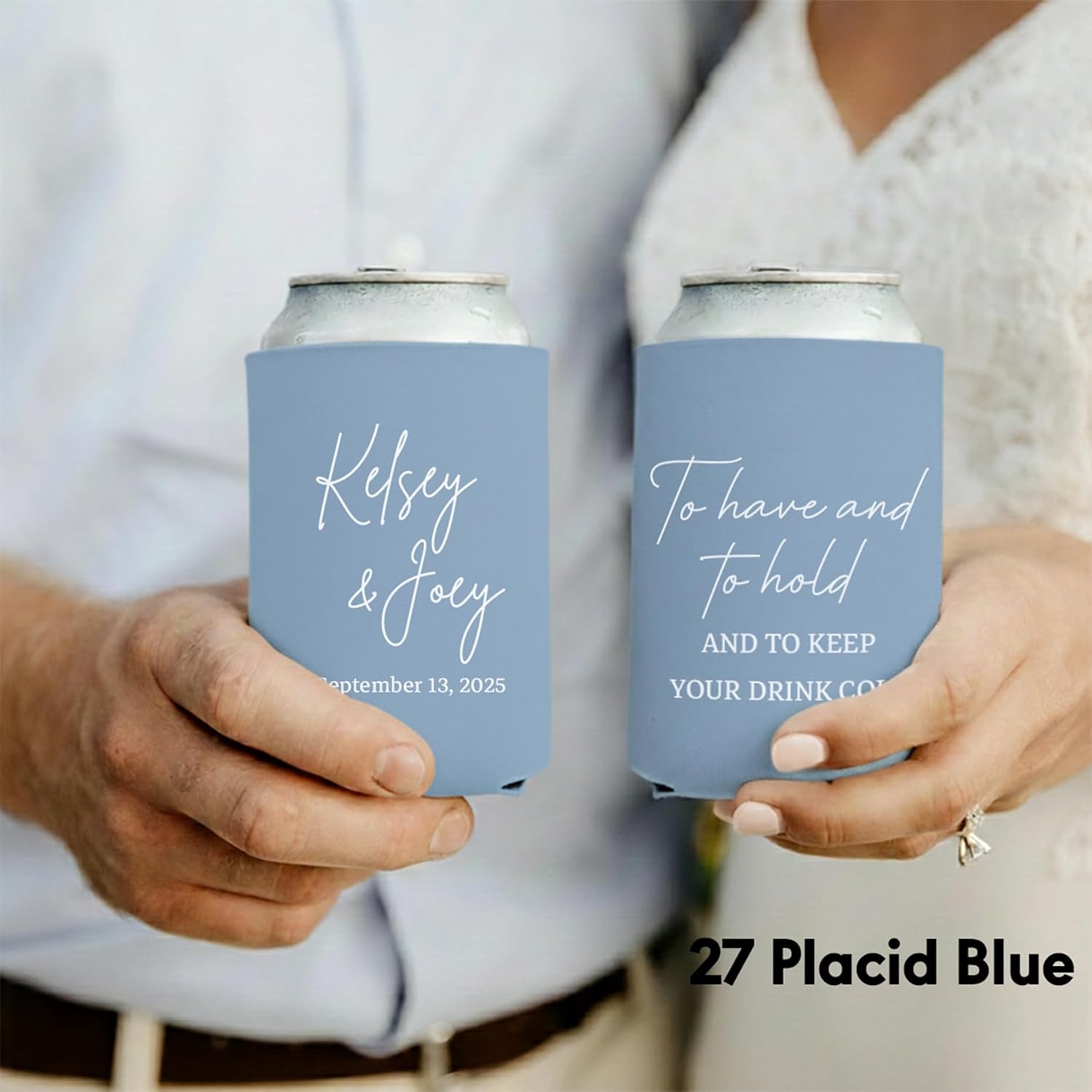
If you’ve ever cleared out a junk drawer and found a foam sleeve printed with someone’s wedding date still wrapped around a can in the back of your fridge — you already understand why can cooler favors work. A can cooler (also called a koozie, a can sleeve, or a drink insulator, depending on who you ask) is a simple foam or neoprene sleeve that slides over a beverage can to keep it cold and your hand dry. They cost a few dollars each, they weigh almost nothing to ship, and — critically — guests actually use them long after the event is over. For couples, hosts, and event planners currently weighing favor options, this guide breaks down the full buying decision: material tiers, personalization methods, realistic costs, lead times, and the tradeoffs that trip up even experienced planners.
The reason this category keeps showing up in buying conversations is simple: survivability. Per Brides’ roundup of wedding favors guests actually keep, practical, everyday items dramatically outpace decorative keepsakes in long-term retention. A can cooler lives in a kitchen drawer or a cooler bag. It gets used at backyard cookouts, beach days, and tailgates — carrying your event’s date and monogram into years of casual use. That’s a marketing reach most branded items can’t touch at this price tier.
What You’re Actually Choosing Between: Material and Print Tiers
The can cooler market splits cleanly into three material tiers, and choosing the wrong one for your event context is the most common planning mistake.
Foam (collapsible) sleeves are the baseline. They fold flat, ship at almost no incremental cost, and run $1.50–$4.50 per unit in quantities of 50 or more. The tradeoff: foam compresses and tears with heavy use, and the print surface is technically a paper wrap or a heat-applied graphic — not embedded into the material. Reviewers and bulk buyers consistently note that foam sleeves look sharp in photos and degrade faster in real-world use. For budget-conscious orders where you need 150+ units and cost is the primary constraint, foam is defensible. For anything positioned as a keepsake, it undersells.
Neoprene (the wetsuit material) is the mid-tier workhorse. Neoprene can coolers — typically 4mm thick — hold their shape, insulate meaningfully better than foam, and accept full-color sublimation printing, which bonds ink directly into the material rather than sitting on top of it. Per Martha Stewart Weddings’ coverage of personalized favor trends, neoprene sleeves have become the default recommendation for weddings and milestone celebrations because they photograph well, feel substantial in hand, and survive years of dishwasher cycles. Price range: $4–$9 per unit at 50-piece minimums, dropping toward $3.50 with 144+ units.
Stainless steel and hard-shell insulators (think: slim can coolers with a vacuum-sealed wall, similar to a travel tumbler’s construction) are the premium tier. These carry per-unit costs of $12–$22 depending on customization depth, but owners consistently report using them for years. For corporate welcome gifts, rehearsal dinner favors at higher-end events, or any context where the gift needs to feel like a considered object rather than a throwaway, this tier justifies the spend. The catch is lead time: laser engraving on stainless requires 3–5 additional business days over sublimation printing, and most vendors won’t rush it.
Personalization Methods: What “Monogrammed” Actually Means
The word “monogrammed” gets used loosely in product listings, and it matters for final quality.
Screen printing is single-color ink applied through a stencil. It’s durable on neoprene and foam, reads cleanly from a distance, and is the cheapest personalization method. The limitation: it handles one to three colors well and struggles with fine detail. If your design is a clean monogram in a block font, screen printing delivers excellent results. If your design includes a watercolor crest, gradient, or script with fine serifs, screen printing will disappoint.
Sublimation printing is the current industry standard for photo-quality or multi-color designs on neoprene. The dye becomes part of the fabric at a molecular level, meaning it won’t crack, peel, or fade the way surface inks do. Across vendor review aggregators and favors-category coverage from The Knot’s 2025 Real Weddings Study, sublimation-printed neoprene favors receive the most consistent positive feedback on perceived quality. This is the method to specify if your design has more than two colors or includes a pattern or photo element.
Laser engraving applies to hard-shell and stainless options. It removes material rather than adding ink, producing a permanent mark that won’t fade regardless of use. For premium corporate gifts or luxury rehearsal dinner favors, laser-engraved stainless is the choice that signals intentionality. There’s no color in the mark itself — just the raw metal — which means it reads elegantly on brushed finishes and tends to disappear on darker or highly polished surfaces.
Heat transfer / vinyl decal is common in smaller-batch Etsy vendor production. It’s accessible and versatile for custom designs, but reviewers consistently flag edge-peeling after 6–12 months of regular use. Fine for a low-cost, personal-touch order; less appropriate when longevity is a stated priority.
By the Numbers: Per-Unit Cost at Quantity Breaks
| Quantity | Foam Sleeve | Neoprene (sublimation) | Stainless Insulator |
|---|---|---|---|
| 25 units | $3.50–$5.00 | $7.00–$11.00 | $18–$25 |
| 50 units | $2.50–$4.00 | $5.50–$8.50 | $15–$20 |
| 100 units | $1.75–$3.00 | $4.00–$6.50 | $12–$16 |
| 144+ units | $1.50–$2.50 | $3.25–$5.00 | $10–$14 |
Ranges reflect 2026 vendor pricing across mid-tier promotional products suppliers. Setup/plate fees ($25–$75 per color) are excluded and should be factored into small-quantity math.
The setup fee issue is real and often surprises first-time bulk buyers. A 25-unit foam order at $3.50/unit looks like $87.50 total — but a $50 screen-printing setup fee brings the effective per-unit cost to $5.50. At 100 units, that same $50 setup fee becomes $0.50 per unit and disappears into the budget. This is why the math at low quantities frequently pushes buyers toward neoprene-at-higher-quantity rather than foam-at-low-quantity: the per-unit economics often end up similar, and you get a substantially better product.
Lead Times and the Traps That Catch People
Based on current 2026 vendor lead-time disclosures across the promotional products category, standard production windows run:
- Foam, screen-printed: 7–10 business days after proof approval
- Neoprene, sublimation: 10–14 business days after proof approval
- Stainless, laser-engraved: 12–18 business days after proof approval
- Rush production surcharges: typically 20–35% added to the order total, and not all vendors offer rush on custom work
The proof approval step is where projects stall. Most buyers underestimate how long back-and-forth on artwork takes. A vendor submits a digital proof; the buyer needs sign-off from a partner, planner, or client; revisions happen; a second proof goes out. Realistically, budget 3–5 business days for proof approval before production even begins. If your event is 6 weeks out and you haven’t ordered yet, you’re not comfortable — you’re at the edge. Eight weeks out is the honest minimum for neoprene; ten weeks for stainless if you want zero stress.
Per Bizzabo’s 2025 Event Experience Report, last-minute gifting decisions are among the top five logistical pain points for corporate event managers — and the can cooler category is particularly vulnerable because buyers assume “it’s just a koozie, how complicated can it be?” The answer: complicated enough that rushing it costs you real money.
Where to Source: Vendor Category Map
For most orders in the 50–144 unit range, established promotional products vendors (4imprint, Crestline, CustomInk’s promo division) offer the best balance of quality consistency, proof-turnaround speed, and reliable ship dates. Pricing is transparent, minimums are reasonable, and customer service is built for exactly this use case.
For premium-tier designs — particularly custom illustrated crests, multi-color sublimation on neoprene, or styled packaging — Etsy artisan vendors consistently earn stronger reviews on design quality and bespoke execution. The tradeoff is lead time unpredictability and no rush-order infrastructure. Martha Stewart Weddings’ editorial coverage of personalized favor vendors frequently highlights small-batch Etsy suppliers for their design sophistication, while noting that buyers should confirm production windows in direct message before placing an order.
For stainless-tier corporate gifting at 50+ units, promotional products distributors with dedicated corporate accounts (SAGE-networked distributors, branded merchandise agencies) will offer better pricing than direct consumer portals and can negotiate custom packaging — branded tissue, branded boxes — as part of a single PO.
The Decision Rule
Here’s the honest if/then framework for where you are right now:
If your budget is under $5/unit and quantity is 100+: Neoprene sublimation at 144 units wins on both quality and effective per-unit cost once setup fees are amortized. Skip foam unless you’re genuinely cost-constrained past that floor.
If your budget is $6–$12/unit and design is a priority: Neoprene sublimation with full-color custom artwork, sourced from a vetted Etsy vendor with a 10-week lead time minimum. This is where the favor earns its keep aesthetically.
If your budget is $12–$22/unit and the gift needs to feel like a gift: Stainless vacuum-insulated slim cooler with laser engraving. Order 12 weeks out. Accept that there’s no rush option. This tier is appropriate for rehearsal dinner favors at elevated events, VIP gifting suites, or corporate executive tokens where the object’s quality reflects on the brand.
If you’re under 6 weeks out: Call vendors on the phone, not the website chat. Ask directly whether your in-hands date is achievable before you approve the proof. A vendor who hedges is telling you something. A vendor who guarantees it in writing can be held to it.
The can cooler category earns its reputation in favor conversations because it sits at a rare intersection: genuinely useful, visually customizable, budget-scalable, and — per the long-term retention data cited in The Knot’s 2025 Real Weddings Study — the kind of thing guests actually keep. The buying decision is mostly about not letting lead-time complacency or setup-fee math catch you off guard. Get the timeline right and the rest of this category is straightforward.